
The split-incentive problem is one of the hardest to solve.
96.5% of respondents to a BCO office study rated sustainability certification as essential to office quality, and sustainability was cited in 60% of renewal decisions.
Solar infrastructure engineered for multi-tenant buildings, delivered with minimal disruption to the businesses already operating inside — built for the landlords, building managers and Finance Directors running serviced offices and flexible workspace.








What the numbers say about serviced offices & flexible workspace right now.
96.5% of respondents to the BCO's regional office study rated sustainability certifications (EPC, BREEAM, NABERS) as essential to office quality — the highest-rated factor.
Sustainability is cited in 60% of office lease renewals and 58% of relocation decisions (where it's the single biggest factor).
Source: CBRE, European Office Occupier Sentiment Survey 2025
There are 4,270 flexible workspace locations across the UK (Q1 2026), with occupancy at a record ~83%.
The landlord-tenant 'split incentive' — where the landlord funds upgrades but the tenant reaps the lower bills — is a well-documented barrier to sustainability investment in leased offices.
Source: General industry context
Figures are third-party sourced and current at time of publication. Each links to its original source above.
In this sector's language.
The pressures a serviced offices & flexible workspace team actually voices — not the ones a brochure assumes.
"We want to reduce costs, but our tenants pay the energy bill, not us"
The split-incentive problem: the landlord funds the infrastructure, but tenants often see the immediate benefit.
"We can't disrupt the businesses already operating in the building"
A multi-tenant building has several operations to work around simultaneously.
"We want to attract environmentally-conscious tenants and occupiers"
Sustainability credentials increasingly influence a prospective tenant's decision.
"Our roof space is constrained by the building's architecture"
Many multi-tenant buildings weren't designed with solar in mind.
Where does your site actually sit?
Five quick questions. No form, no number to chase — a directional read on your real constraint, and the fastest route in.
Which of these sounds most like you?
The split incentive many providers won't address.
Multi-tenant buildings carry a structural problem most solar installers don't address: the landlord typically funds the infrastructure, but tenants often see the direct energy benefit — and any installation has to work around several live businesses at once.
The split-incentive problem
Funding structure has to make commercial sense for the landlord even where tenants capture some of the energy benefit directly.
Multiple live occupiers
Installation has to be phased and scheduled around several separate businesses' operating hours.
Architectural constraints
Building appearance and existing roof design often limit array placement more than a purpose-built industrial or retail shed would.
Green lease and tenant attraction
Increasingly, sustainability credentials are a genuine factor in a prospective tenant's decision.
The methodology — not just the claim.
- 01
Building and occupancy audit
Assessing architecture, roof constraints and multiple tenants' operating patterns before any design work starts.
- 02
Funding-structure assessment
Addressing the split-incentive question directly: landlord CapEx, tenant service-charge recovery, or a fully funded route, agreed before system sizing.
- 03
Multi-occupier delivery planning
Phasing installation around several live tenants' schedules, not a single site contact.
- 04
Integrated design
Solar designed to work within the building's existing architecture and roofline, rather than assuming a blank industrial roof.
Problem, solution, outcome.
- 1 · Problem
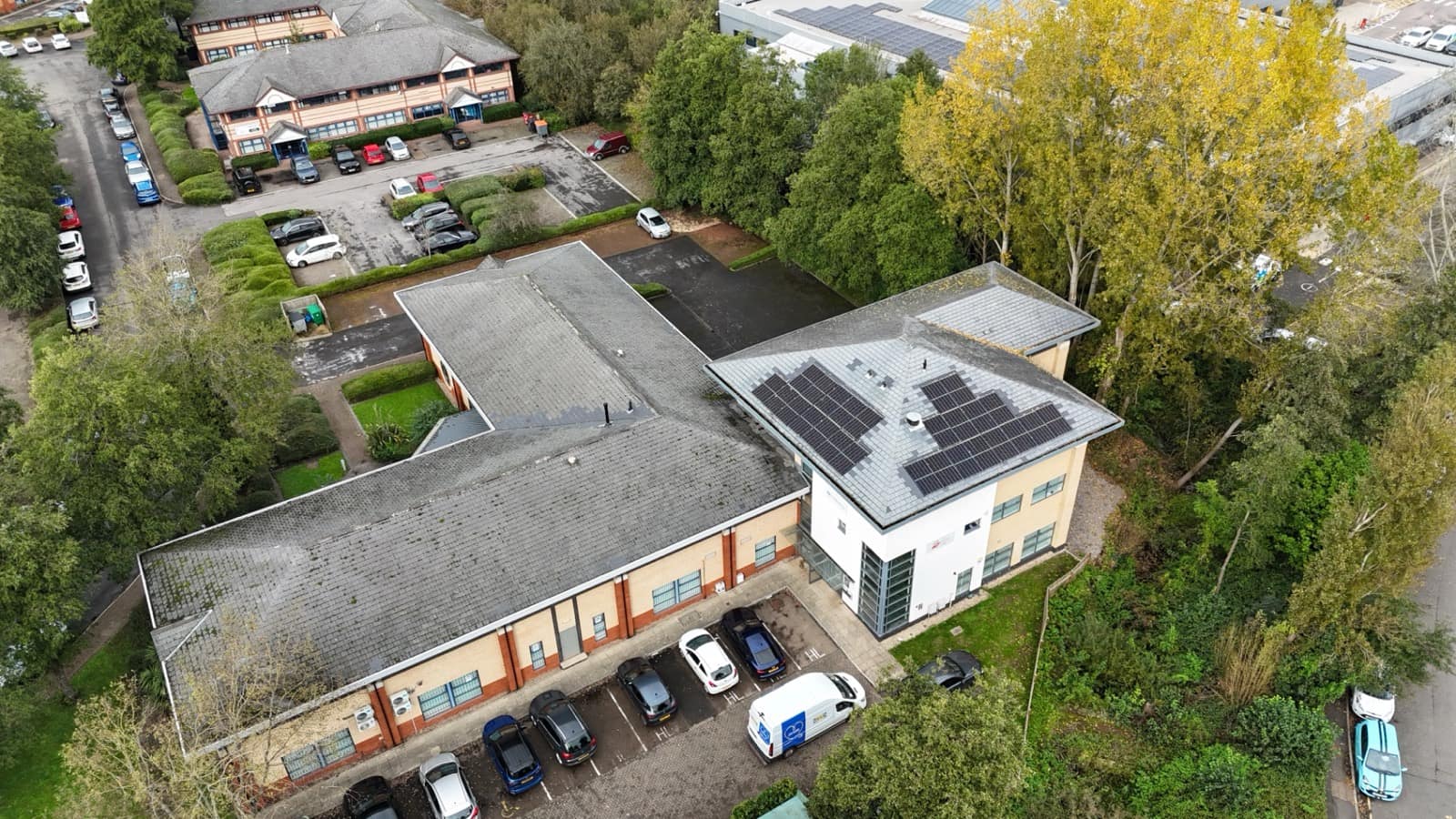
Charter House, Britannia House and Quest House each wanted to integrate renewable generation into existing multi-tenant office infrastructure — reducing reliance on imported electricity, complementing the building's architecture, and creating a more attractive environment for environmentally-conscious tenants.
- 2 · Solution
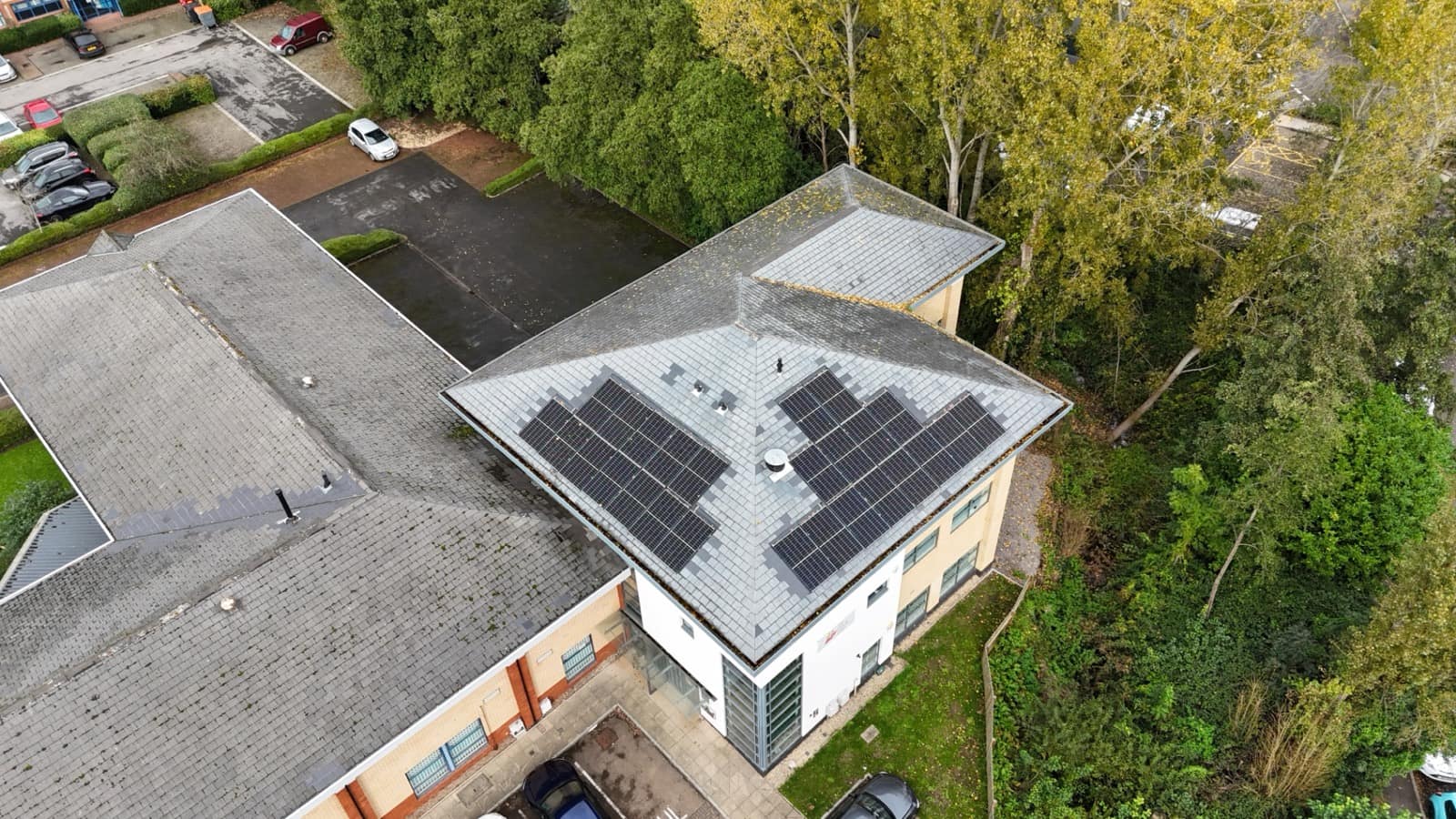
Nuvolt delivered solar solutions engineered around each building's specific architecture and occupancy — 46 kWp across 145 panels at Britannia House, and tailored systems at Charter House and Quest House — with installation planned to minimise disruption to businesses already operating inside.
- 3 · Outcome
Charter House: 1.82 tonnes of CO₂ saved annually. Quest House: 8.3 tonnes of CO₂ saved annually, strengthening its environmental credentials for tenants. Britannia House: 46 kWp generating from 145 panels integrated into the building's existing architecture.
We've done this before.
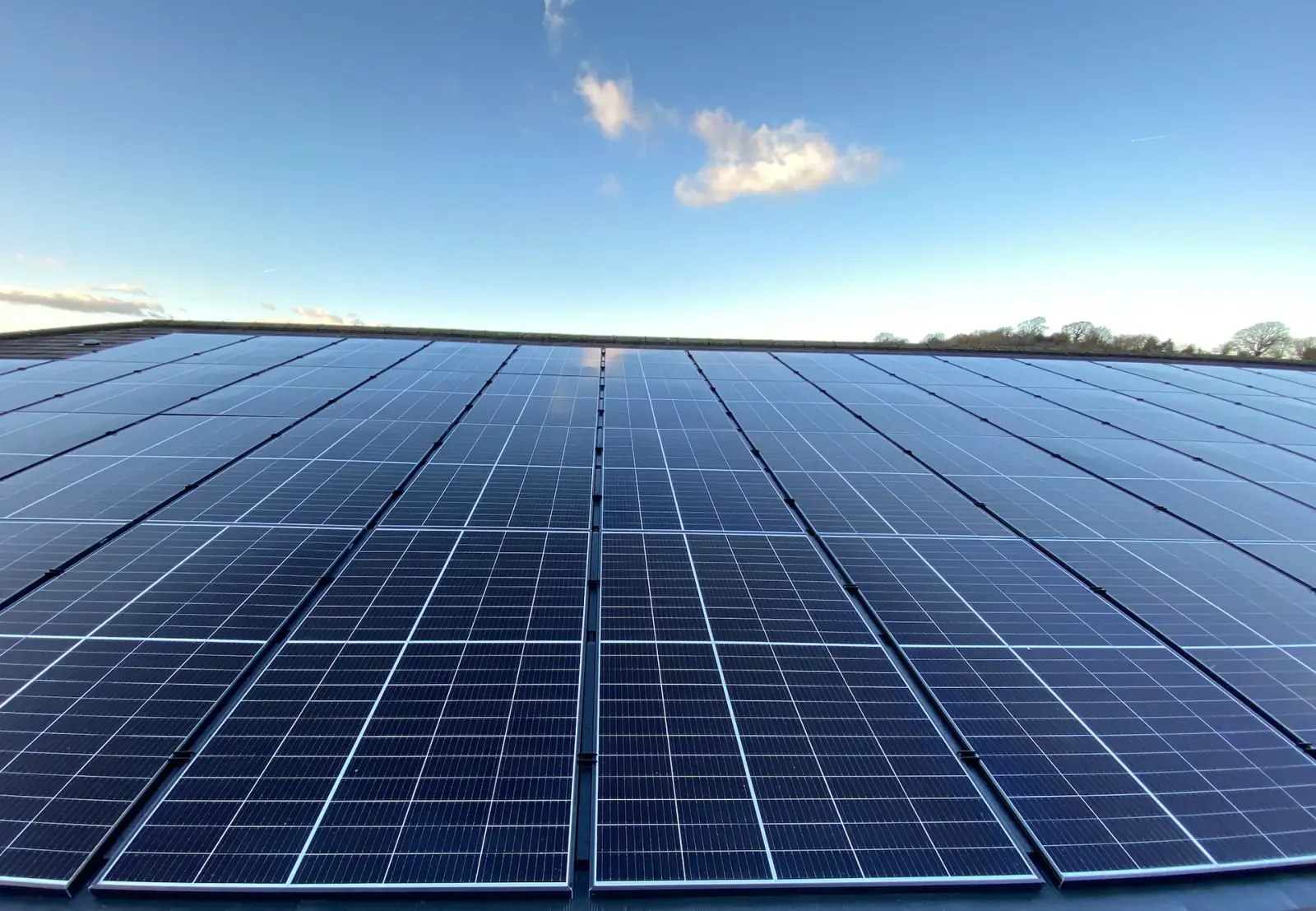
46 kWp across 145 in-roof panels integrated into an existing multi-tenant office building's architecture.
The commercial upside, in plain terms.
Funding structured around the split incentive
A commercial case that works for the landlord even where tenants capture some of the direct energy benefit.
Phased around multiple live tenants
Installation scheduled around several separate businesses' operating hours, not a single site contact.
Sustainability credentials that attract tenants
Verifiable environmental credentials that genuinely help win and retain environmentally-conscious occupiers.
Lower service-charge costs
On-site generation that can reduce the energy element of the service charge passed on to tenants, where the lease and service-charge terms allow.
Array designed to the building's architecture
Solar integrated within the existing roofline and appearance, rather than forced onto a building that wasn't designed for it.
One partner across a multi-tenant scenario
A single accountable partner managing a technically and commercially more complex building than a single-occupier site.
Benefit statements are illustrative of Nuvolt's engineering approach. Project-specific figures are modelled against your own site data; sector statistics are drawn from the third-party sources cited on this page.
How we deliver it, end to end.
One accountable partner across the whole engagement — from the first load audit to lifetime operation.
A line for every role that has to sign this off.
Finance Director / CFO
A funding structure that makes commercial sense as landlord even where tenants see some of the direct energy benefit — the split-incentive problem addressed head-on.
Operations Director
Installation phased around multiple live occupiers' operating hours, minimising disruption to businesses that don't have the option of closing for the day.
Sustainability Lead
Verifiable environmental credentials that genuinely help attract and retain environmentally-conscious tenants.
Managing Director
One accountable partner managing a technically and commercially more complex multi-tenant scenario than a single-occupier site.
Suited to this sector.
Funding gets equal weight to engineering. The right structure follows the business, not the other way round.
The split-incentive problem in multi-tenant buildings makes Energy-as-a-Service and asset finance particularly relevant — they let a landlord improve sustainability credentials and reduce service charge costs without carrying the full capital burden alone.
The objections we hear most.
The questions every serviced offices & flexible workspace team puts to us before a first conversation — answered straight.
Still have a question? Talk to us
System sizing for a multi-tenant building is shaped by architecture, roof constraints and the split-incentive funding question — as much as by demand.
Ranges are illustrative of Nuvolt's engineering approach and must not be read as a quote, estimate or guarantee. Every site is sized against its own data.
- 1Array design has to work within the building's existing architecture and roofline, as at Britannia House, rather than assuming a blank industrial roof.
- 2Funding structure should be agreed with the split-incentive question in mind from the outset — landlord CapEx, tenant service-charge recovery, or a fully funded route.
- 3Installation phasing needs a schedule agreed with multiple tenants, not a single site contact.
A short conversation. No quote, no pitch — a commercial view of where your multi-tenant building's energy position actually sits.
Request a building and funding-structure review. We'll assess your building's architecture and map a funding approach that works given who actually pays the energy bill — no quote, no pitch, before any system size gets discussed.
- 1Share your building details and tenancy arrangement — who occupies the building and who pays the energy bill.
- 2We assess the architecture and roof constraints, and map a funding approach that addresses the split incentive.
- 3You get a commercial read on your building's energy position — before any system size is discussed.
Let's have a strategic conversation about your energy position.
An assessment, a benchmark, a roadmap — whichever is most useful. A short conversation with engineers who run commercial energy every day, not a sales call.