
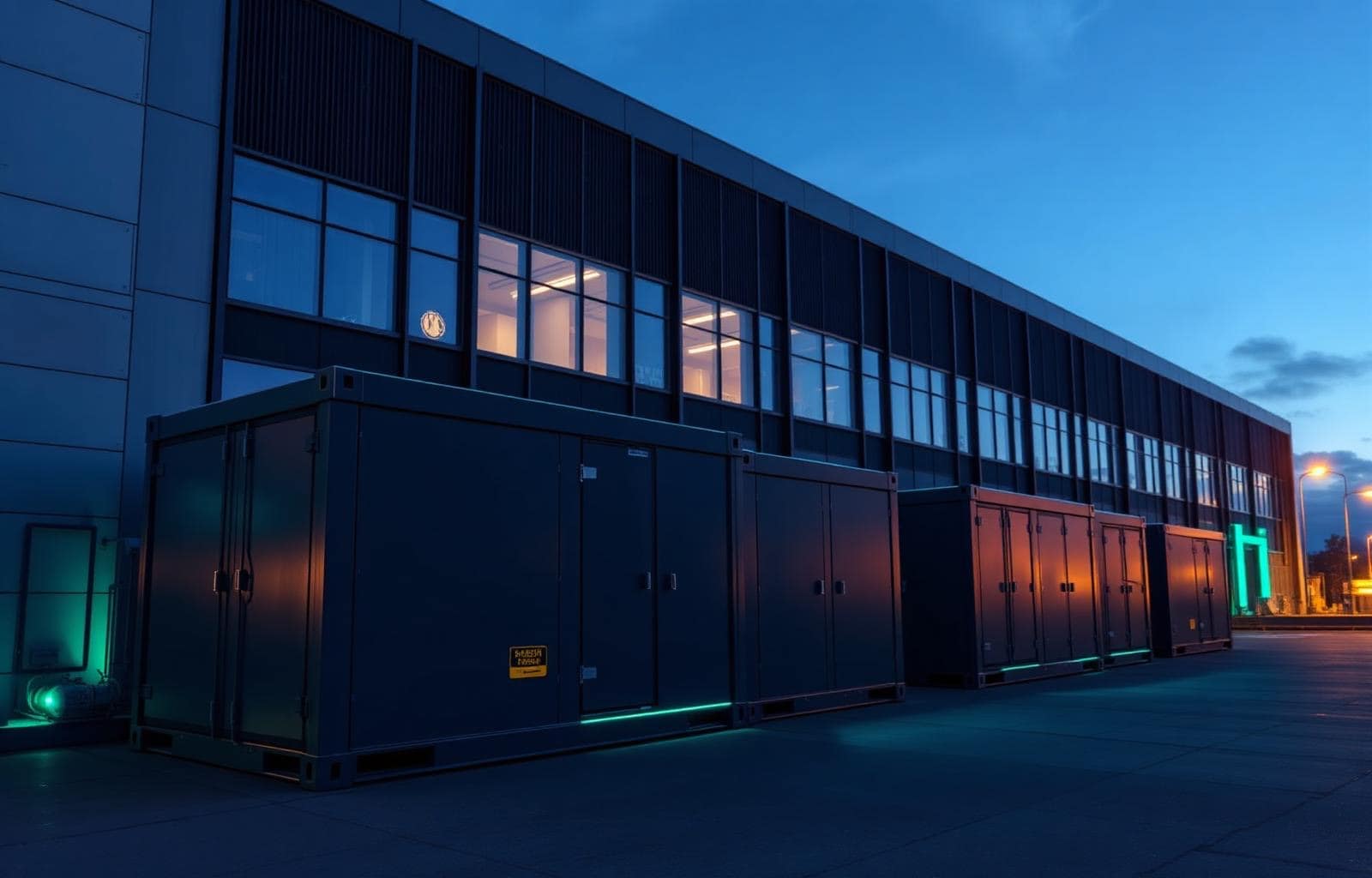
Commercial battery storage — when batteries earn their keep.
A practical guide to the revenue stack: tariff arbitrage, peak-band avoidance, solar uplift and grid-services income on UK commercial sites.
Commercial battery storage pays back when the revenue stack is layered correctly: tariff arbitrage, red-band peak avoidance, solar self-consumption uplift, and grid-services income. A single revenue stream rarely justifies a battery on its own; three or four together typically deliver 5–10 year payback. The risk is buying capacity for one use case and stranding it.
What Commercial Battery Storage actually is
A site-based lithium-ion (typically LFP) energy storage system, sized in kW (power) and kWh (energy), connected behind the meter to shift consumption in time, capture solar export, avoid peak tariffs, and earn revenue from grid balancing services.
A backup power source first and foremost. UPS-grade resilience is a different specification. Commercial batteries are an economic asset that happens to also provide some resilience.
- Red-band tariff
- The premium DUoS charge applied during the highest-demand winter weekday hours (typically 16:00–19:00). Avoiding red-band import is one of the largest single saving levers.
- Tariff arbitrage
- Charging the battery when grid prices are low and discharging when prices are high. Effective on day-ahead and dynamic tariffs.
- DUoS / TNUoS
- Distribution and Transmission Use of System charges — non-commodity charges added to your bill, often 30–50% of the total. Batteries reduce these.
- DFS / Balancing services
- National Grid ESO Demand Flexibility Service and other balancing markets pay batteries to absorb or release energy on instruction.
- Round-trip efficiency
- The energy out divided by energy in across a full charge/discharge cycle. Modern LFP systems achieve 88–92%.
- Cycle life
- Number of full charge/discharge cycles before reaching end-of-warranty capacity (typically 80%). Modern LFP: 6,000–10,000 cycles.
How it works
Six checkpoints from data to commissioning. Scroll to step through each one.
- Step 01
Map the revenue stack
We model your half-hourly import and tariff structure (commodity + DUoS + TNUoS + capacity market levies). Each line that the battery can reduce becomes a stackable revenue stream.
- Step 02
Size for power and energy independently
A battery has two ratings: kW (how fast it can discharge) and kWh (how much it can store). The right ratio depends on whether you're avoiding short peaks or shifting bulk load.
- Step 03
Connection design
G99 DNO application, switchgear integration, and import/export limitations are all designed alongside the battery. Co-location with existing or planned solar is sized as one system.
- Step 04
Optimiser layer
A battery without smart control is just a box. We integrate with optimisation platforms that dispatch automatically against tariffs and grid signals — measurable revenue from day one.
- Step 05
Live monitoring & revenue reporting
Every kWh in and out is tracked. Monthly reports show actual revenue against forecast across each stream — arbitrage, peak avoidance, grid services.
Commercial impact
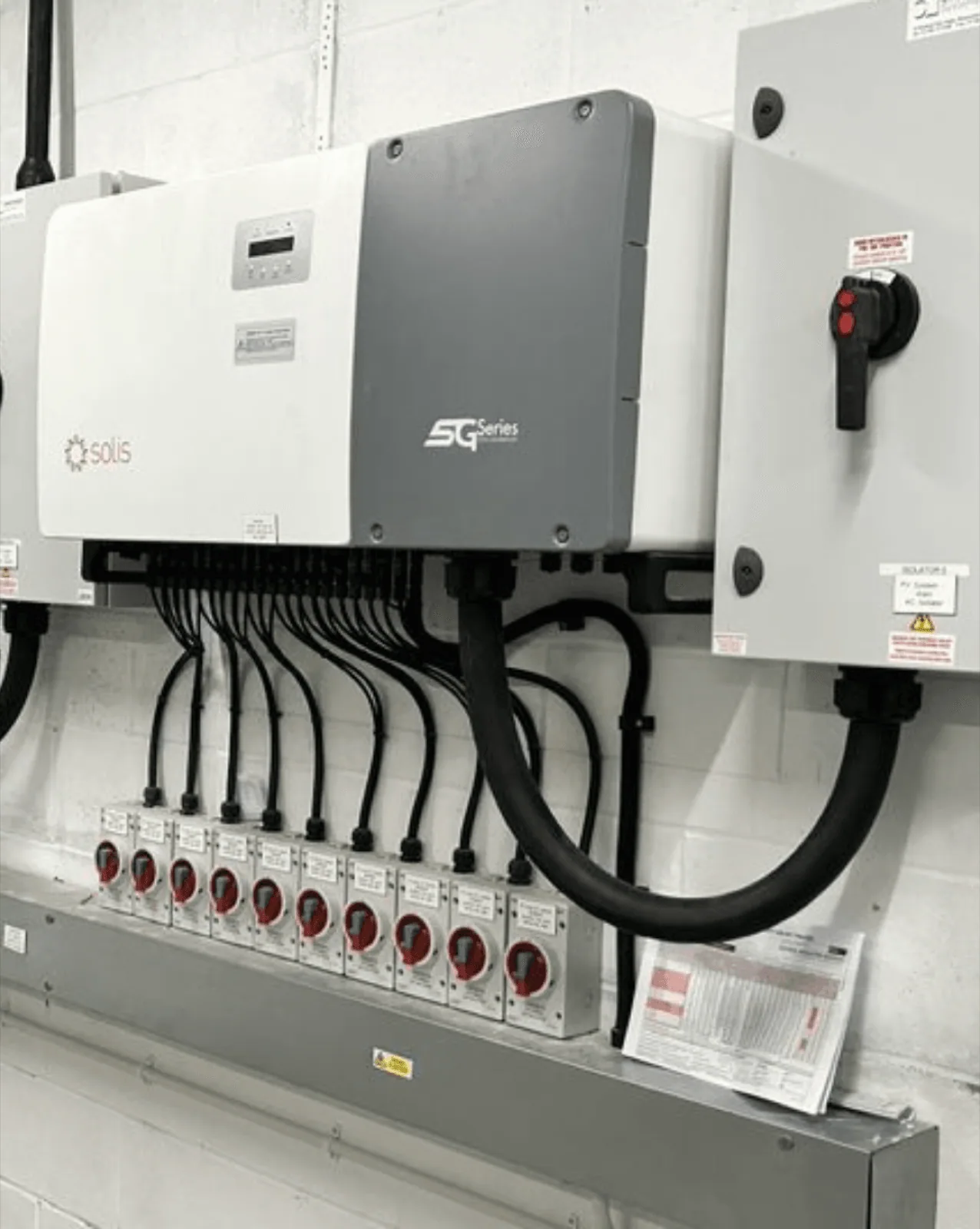
Battery economics are sensitive to assumptions in a way solar is not. A solar kWh has a fixed value (your import rate). A battery kWh has a value that depends on when you charged it, when you discharged it, and what market signal you responded to. The right modelling reveals strong returns; lazy modelling kills the project.
- 01
Tariff arbitrage alone rarely justifies a battery; combined with peak-band avoidance + solar uplift, payback typically lands in 5–10 years.
- 02
Grid-services participation (DFS, Dynamic Containment, Balancing Mechanism) adds 1–3p/kWh of additional revenue with no incremental capital.
- 03
Capacity Market revenues are available to batteries above 1 MW with sufficient duration.
Operational impact
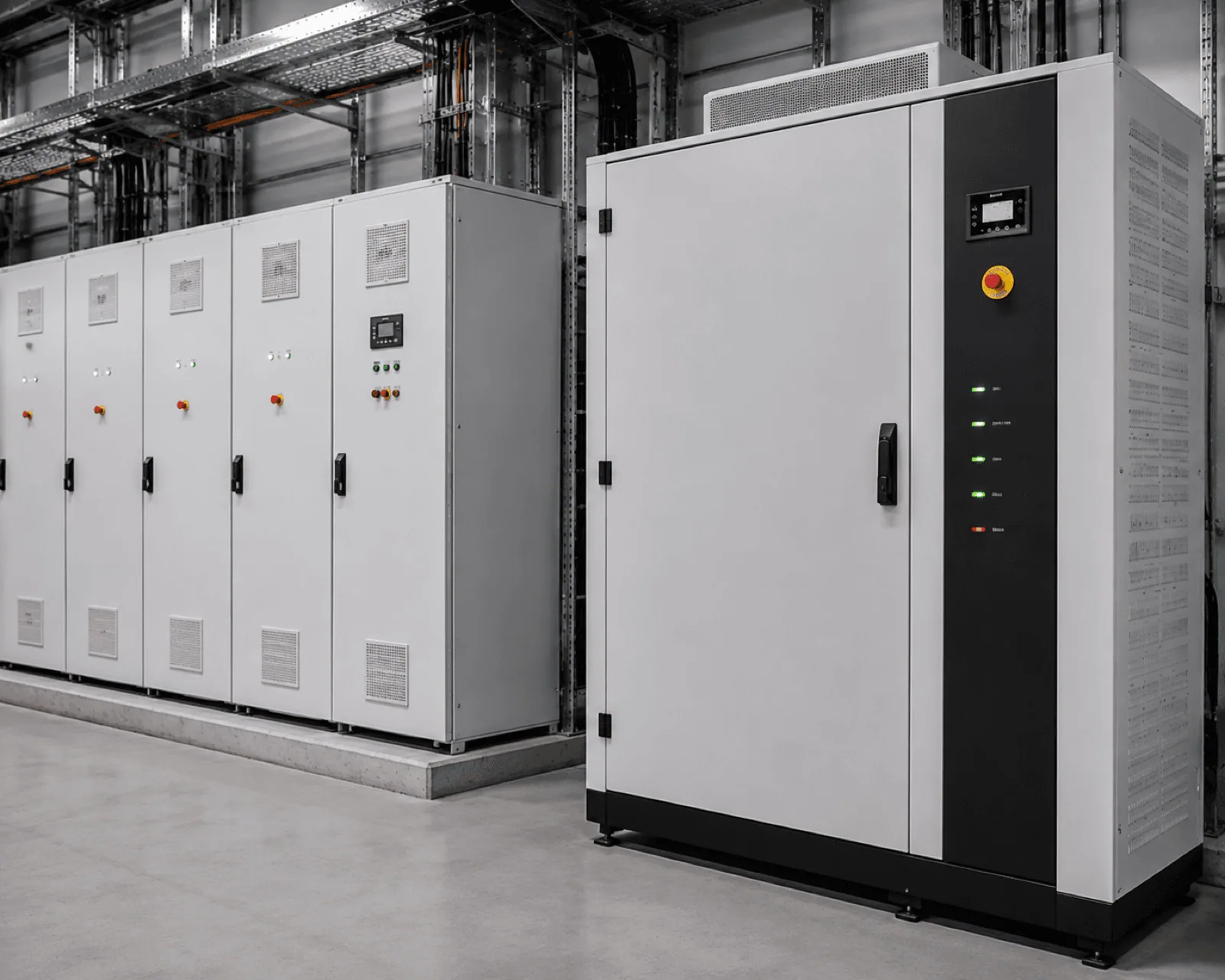
Modern battery systems are designed to operate quietly in the background. For most organisations, the operational considerations are site space, connection requirements and maintenance planning rather than day-to-day management.
- 01
Commercial battery storage requires minimal operational input. Monitoring, diagnostics and performance management are typically handled remotely by the service provider.
- 02
Most systems are containerised or cabinet-based and can be installed externally with limited disruption to existing operations, access routes or production activities.
- 03
Modern LFP battery systems are designed for long-term daily cycling, providing reliable operation for 10-15+ years with planned maintenance and warranty support.
Risks — and how we de-risk them
We design to economic dispatch first; resilience capability is a configurable add-on, not the primary use case. Keeps the asset earning.
Multi-revenue-stream stacking insulates the project. A regime change that closes one stream rarely closes all four.
We specify hardware that supports multiple optimisation platforms. The dispatcher is replaceable; the asset isn't locked in.
Pre-application capacity discussion before commercial commitment. Import/export-limited designs to land within available headroom.
Tier-1 LFP cells with warranties tied to throughput. Augmentation strategy planned at design stage.
BS EN IEC 62933 compliance, FM Global / NFPA 855 alignment, full fire-risk assessment and engagement with insurer ahead of commitment.
How it gets paid for
Four ways to fund the same physical asset. Pick the one that matches your balance sheet and your time horizon.
One battery, four revenue streams, twenty-four hours
Charge cheap, discharge expensive, soak up solar at noon, sell back at the evening peak. The bars below are positive when the battery is exporting energy and negative when it's absorbing it.
How this stacks up against the alternatives
| Battery storage | Demand-response only | Larger grid connection | Do nothing | |
|---|---|---|---|---|
| Avoids red-band peaks | Yes | Partial (load shed) | No — pays them | No |
| Captures solar export | Yes | No | No | No |
| Earns grid-services revenue | Yes | Some | No | No |
| Capital required | ££ or zero | Low | £££ (DNO works) | Zero |
| Asset life | 15+ yrs | n/a | Permanent | n/a |
| Payback range | 5–10 yrs | n/a — opex saving | Long / never | n/a |
Battery storage is not a hedge against solar — it's a multiplier. The economics work when the revenue stack is built deliberately, not assumed. The wrong battery is an expensive box; the right one is a four-stream income asset.
Questions buyers actually ask
Selected projects

Marston's PLC
Sustainability initiative — headquarters and Phase 1 solar installation across Marston's hospitality estate, delivered with HT Power PPA support.
- System size
- 114.38 kWp
- CO₂ saved
- 17.44 T
- Payback
- 4 years
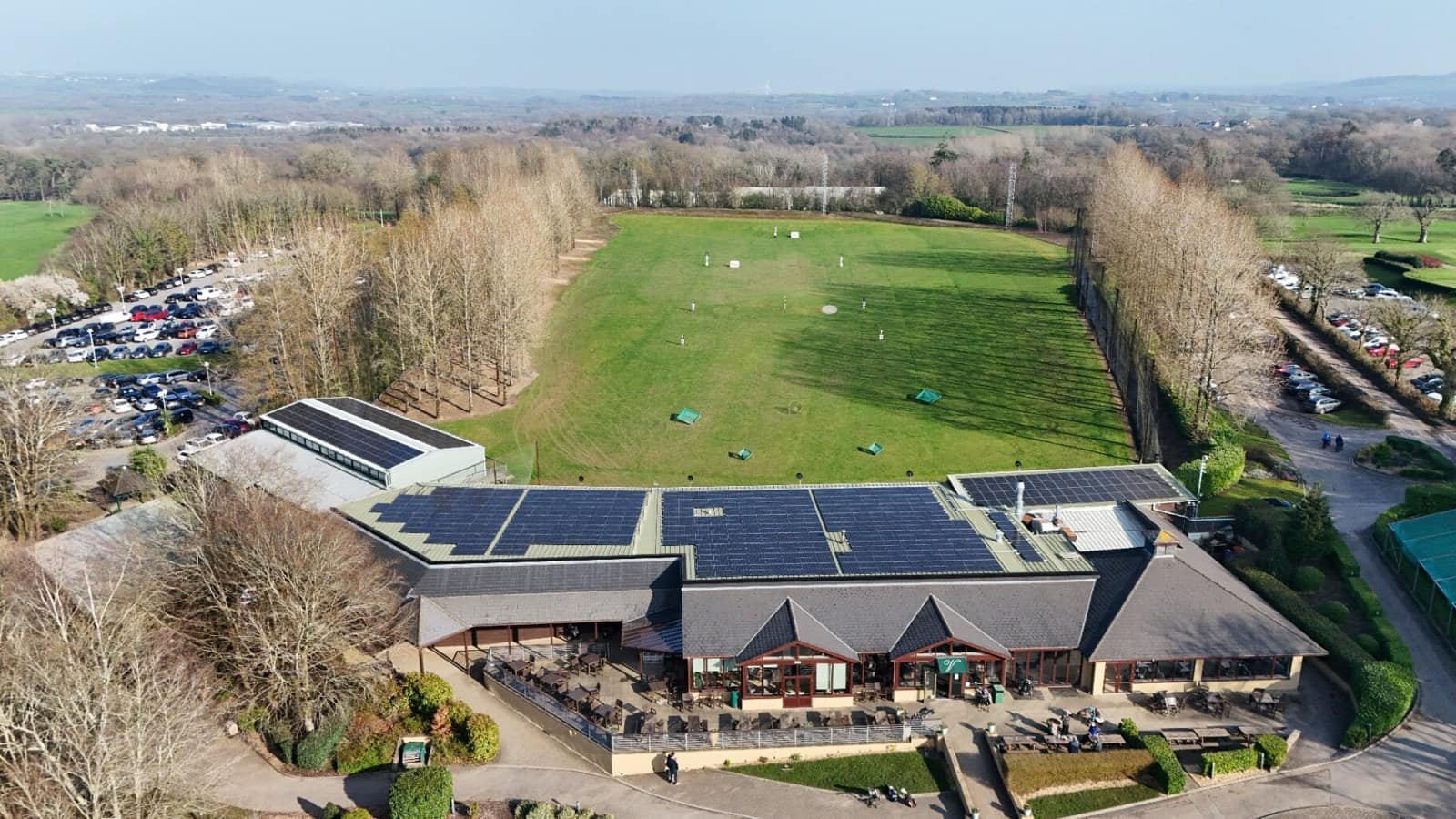
The Vale Resort
Solar PV plus EV charging delivered live across a working luxury resort and golf club.
- System size
- 168.81 kWp
- Year-1 savings
- £43,049.60
- CO₂ saved
- 28.8 T
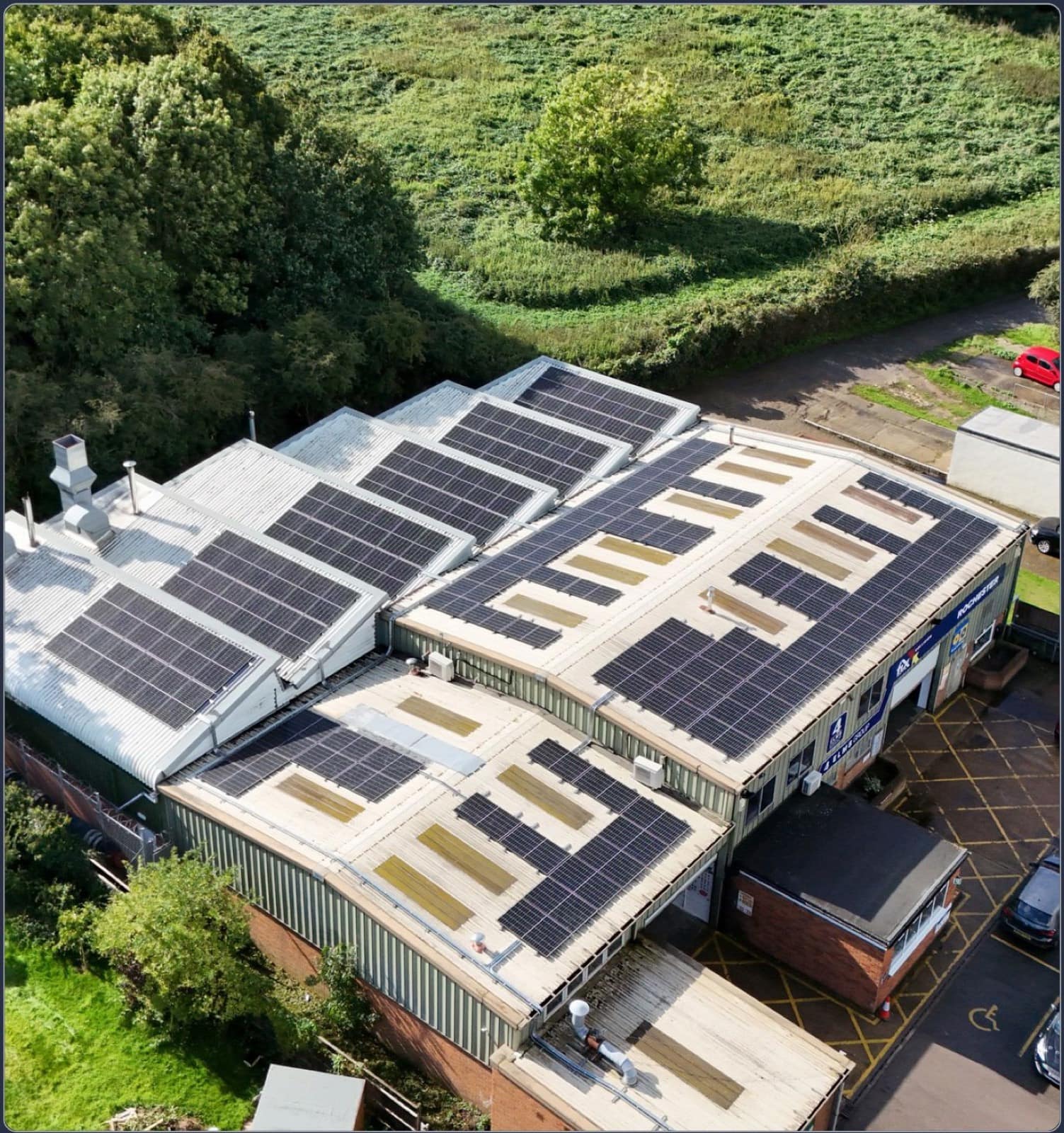
Four Elms Group
Solar PV across a UK network of automotive repair and accident management centres.
- System size
- 117.45 kWp
- Year-1 savings
- £33,632
- Payback
- 3 years
Related solutions
Commercial Solar PV
Bespoke rooftop and ground-mount solar designed to cut your bills and your scope-2 emissions.
EV Charging
Full consultancy, installation and maintenance for charging at any scale, integrated with on-site generation.

Energy-as-a-Service
We design, build, fund and operate your energy assets. You pay a fixed unit rate and start saving from day one.
Ready to model your numbers?
Five quick questions and our team will come back with a tailored proposal — CAPEX, finance, PPA or fully funded.