
How do operators consolidate fragmented energy suppliers into one accountable system?
By replacing the multi-vendor quote-and-procure model with one engineered design, one principal contractor and one lifetime operations relationship.
One contract. One design. One accountable partner.
If this is the conversation happening inside your business, you're not alone — and the symptoms below are usually the first sign.
- Separate vendors for solar, battery, EV and metering
- Quotes that don't add up because they don't talk to each other
- Warranty and performance disputes between suppliers
- Internal teams forced to act as integrators
The cost of leaving this unsolved.
These aren't theoretical risks. They're the compounding business consequences we see when this challenge is left to sit.
Accountability gets lost in the gaps
When five vendors each own a slice, no one owns the outcome. The first time something fails, the cost of that becomes obvious.
Total cost is higher than it looks
Overlapping scopes, duplicated commissioning and integration cost rarely show up on any single quote — but they always show up in the year-one P&L.
Performance leaks
Systems that were never designed to talk to each other operate below their combined potential — usually invisibly.
Internal teams become integrators
Facilities and engineering end up owning the gaps between vendor scopes, which is where risk and rework live.
Get three quotes for each technology.
Three quotes for three technologies is how you end up with five problems.
Engineering, funding, delivery and operations are connected. Splitting them across vendors saves nothing on paper and costs more in practice — in integration, performance and accountability. Buying solar, batteries, EV and metering from separate vendors optimises each line item but produces a system that was never designed as one. The gaps between scopes are where cost, risk and underperformance live.
Three quotes per technology
One engineered system
Split warranties and SLAs
One lifetime accountability
Internal team integrates the gaps
Principal contractor owns the gaps
Optimise each line item
Optimise the whole system
Buy a system, not a stack of scopes.
Brief one partner against the outcome you want — performance, uptime, lifetime cost — and let them engineer generation, storage, EV and metering as one. That single line of accountability is worth more than any saving the cheapest individual quote will ever produce.
A clear path from problem to outcome.
Three deliberate steps, framed around the outcome each one delivers — not the engineering it takes.
- 01
Understand
Map the full system you actually need, not the scopes vendors will quote.
- 02
Design
Engineer generation, storage, EV and metering as one integrated system.
- 03
Deliver & optimise
Operate as principal contractor and lifetime operations partner under one contract.
What success actually looks like.
Technology benefits are easy to list. Business outcomes are what the board signs off against.
Five vendor relationships, five SLAs, no single accountability. Performance disputes between suppliers slow every decision.
One designed system, one principal contractor, one lifetime operations partner. The system performs as it was modelled, and any fault has one owner.
We've done this before.
Edwards Vacuum
One contract. One design. One accountable partner.
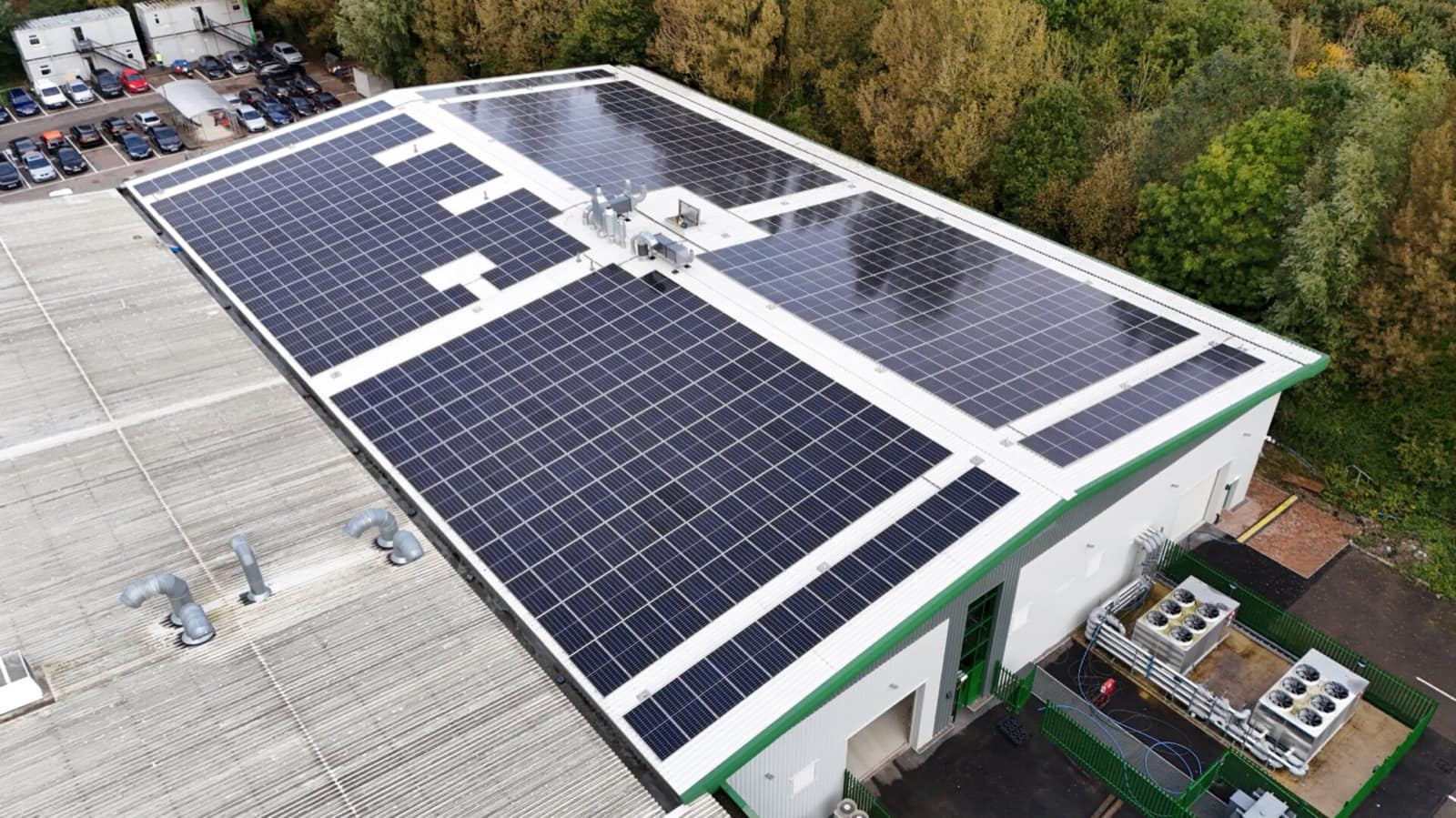
Half-megawatt rooftop solar woven into a live, high-specification industrial manufacturing site.
512 kWp system size · £71,177 year-1 savings
A short way to check whether this is your conversation.
If three or more of the below apply, a strategy conversation is almost always worth the time.
Let's have a strategic conversation about your energy position.
An assessment, a benchmark, a roadmap — whichever is most useful. A short conversation with engineers who run commercial energy every day, not a sales call.