
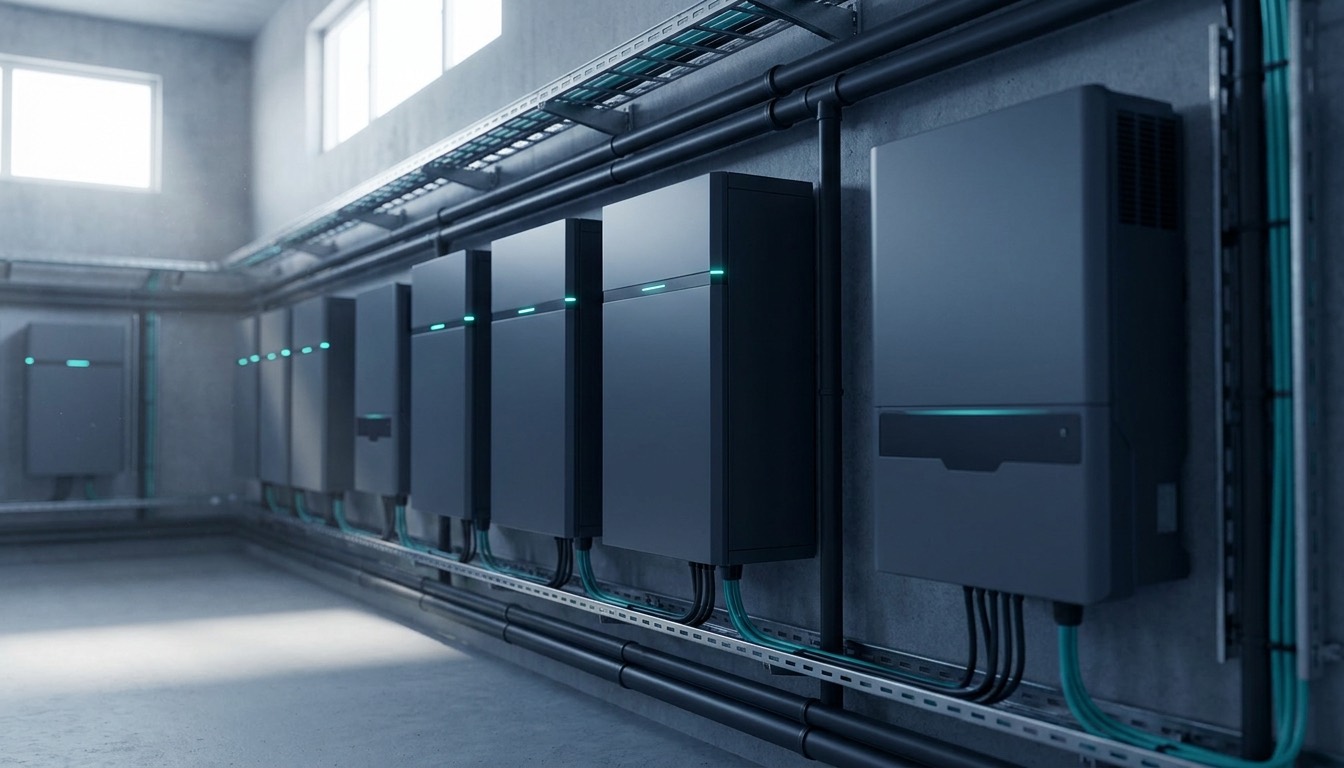
Does commercial solar cover all your electricity costs?
Solar cuts what a site imports, but generation and demand rarely line up. Whether that gap justifies a battery depends on half-hourly site data.
Not usually. Solar electricity used onsite reduces the amount imported from the grid, but it does not necessarily remove every element of a commercial electricity bill.
Generation and demand can also occur at different times. A site may export surplus solar during part of the day, then import electricity later when generation falls below demand.
Whether this gap exists, and whether it is large enough to justify battery storage, depends on the site's actual data.
Solar changes how much electricity you buy. Storage can change when you buy it.
Why does the timing of solar generation matter?
Solar panels generate according to daylight and weather conditions. Your site consumes electricity according to its operating pattern. Those profiles do not always align.
Some businesses use nearly everything their solar system generates. Others export electricity during lower-demand periods, then return to importing from the grid later in the day.
The most reliable way to quantify this gap is to align the site's generation data with its consumption or import-and-export data.
For an existing solar installation, this means analysing when electricity is generated, used onsite, imported and exported. For a proposed system, measured half-hourly demand can be compared with a modelled solar-generation profile.
Where can battery storage fit?
Where a genuine timing gap exists, battery storage can retain some surplus solar and make it available later. This can increase the proportion of onsite generation used by the business. It may also reduce grid imports during more expensive periods.
However, storing electricity does not automatically make it more valuable. The calculation must compare the cost of importing electricity later with the export income being surrendered. It must also account for conversion losses, battery degradation, operating restrictions and the cost of the system itself.
The commercial question is therefore not simply: “Will a battery reduce our bill?” It is: “Where, when and at what cost is the site importing electricity that storage could replace?”
How does the timing gap affect your electricity bill?
Commercial electricity bills can contain more than an energy unit rate. Depending on the contract, meter and connection, the bill may include standing charges, distribution and transmission charges, agreed-capacity charges, excess-capacity charges, reactive-power charges and time-sensitive rates.
These charges do not all respond to battery storage in the same way. Some residual network charges are fixed or banded. They will not fall simply because electricity imports are shifted to another time.
Other costs may be affected by when or how much electricity the site imports. These can include time-banded unit rates, peak-related costs and excess-capacity charges.
A correctly controlled battery may reduce imports during relevant periods. However, it does not necessarily reduce the site's total electricity consumption. Energy is lost during charging and discharging, and a grid-charged battery may increase the total amount imported while reducing imports at more expensive times.
How is a commercial battery correctly sized?
A battery must be sized in both power and energy terms. Its power rating, measured in kilowatts, determines how quickly it can charge or discharge. Its usable energy capacity, measured in kilowatt-hours, determines how much electricity it can store.
The right combination depends on:
- The site's half-hourly demand profile
- Existing or modelled solar generation
- Import and export tariffs
- The timing and size of peak demand
- Agreed import and export capacity
- Any export restrictions
- Battery efficiency and usable depth of discharge
- Expected cycling and degradation
- Warranty conditions
- Planned changes to site operations
- The commercial objective of the system
A larger battery does not automatically produce proportionally greater savings. Additional capacity only creates value when the site can use it frequently enough, or when another defined value stream justifies the investment.
The assessment should therefore start with site data, not a standard battery size or a manufacturer's best-case illustration.
What should a storage assessment include?
A robust assessment will normally begin with at least 12 months of aligned half-hourly data to capture seasonal changes.
For an existing solar site, this should include generation, grid import and grid export. The assessment should also consider the complete import and export tariff, connection capacity and any restrictions imposed by the network operator.
The forecast must then include realistic assumptions for:
- Battery power and usable capacity
- Charging and discharging efficiency
- Degradation over time
- Cycling and warranty limits
- Lost export income
- Capital and operating costs
- Control strategy
- Planned changes in demand
This produces a site-specific forecast with the assumptions clearly shown. It does not guarantee a saving, but it allows the opportunity to be measured rather than assumed.
If you already have solar and have not assessed storage recently, it may be worth revisiting the numbers. Your consumption profile, tariff structure, export arrangements and available battery technology may have changed. Whether the business case now stacks up depends on how those factors combine at your site.
See how Nuvolt sizes and monitors commercial battery storage against real site data.
Commercial battery storageFrequently asked questions
Request a storage assessment
We will compare your generation, consumption, import, export and tariff data to show whether the opportunity genuinely stacks up.
Request a storage assessment